
DOWNTOWN
KAMLOOPS
HERITAGE
WALKING
TOUR
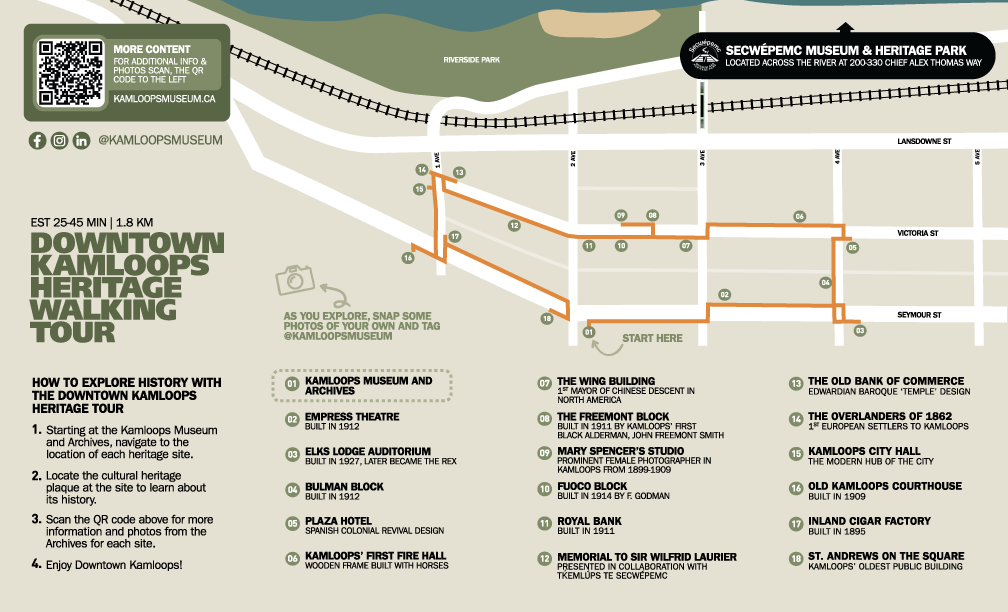
This is a stop on our self-guided tour is designed to be followed along with a physical version of the map available at the Kamloops Museum and Archives or simply enjoy the information below. View all tour stops.
-
Museum Hours
Tuesday - Saturday: 9:30am - 4:30pm
Sunday & Monday: Closed -
Archive Hours
Tuesday - Friday: 1:15pm - 4:00pm
Saturday: By Appointment
Sunday & Monday: Closed
The Empress Theatre
A Touch of Glamour in the Heart of Kamloops | Stop #02
Table of Contents
Related Archives Material
- NA
The Empress Theatre: Two Decades of Silent FIlms
When the Empress Theatre opened its doors in December of 1912, Kamloops had never seen anything like it.
Located at 310 Seymour Street and seating over 700 people, it was twice the size of any theatre the city had known. With plush opera seats, thick carpeting, and neoclassical flourishes—including a semi-draped statue of a woman above the front entrance—it was a statement. The Empress didn’t just show movies. It made movie-going an event.
The theatre was built by a Vernon group of investors, backed by Cornelius O’Keefe of the famed O’Keefe Ranch. They weren’t just selling tickets; they were selling spectacle. And it worked. The Empress quickly became the go-to venue for Kamloops’ film fans and vaudeville lovers alike. From piano-accompanied silent films to travelling acts, the theatre brought the world to Kamloops, one velvet-draped reel at a time.
This wasn’t Kamloops’ first brush with entertainment, of course. Earlier venues like Raven’s Hall and the Kamloops Opera House set the stage for public performance in the late 1800s. But the Empress raised the curtain on a new era of glamour and modernity.
Over time, ownership changed hands, and the city’s theatre landscape began to shift. The Empress closed temporarily in 1914, reopened a year later, and eventually joined a theatre chain owned by R.E. Berry of Vernon.
Even as other cinemas came and went, the Empress stood tall. It entertained generations of Kamloops residents and welcomed touring shows, Hollywood reels, and plenty of popcorn-fuelled memories.
In 1930, after nearly two decades of silent film, the Empress was fully remodelled to welcome the talking picture era—and with a fresh coat of paint, it reopened under a new name: The Capitol Theatre.
Photos From The Archive
Click each image for photo details.