

DOWNTOWN
KAMLOOPS
HERITAGE
WALKING
TOUR
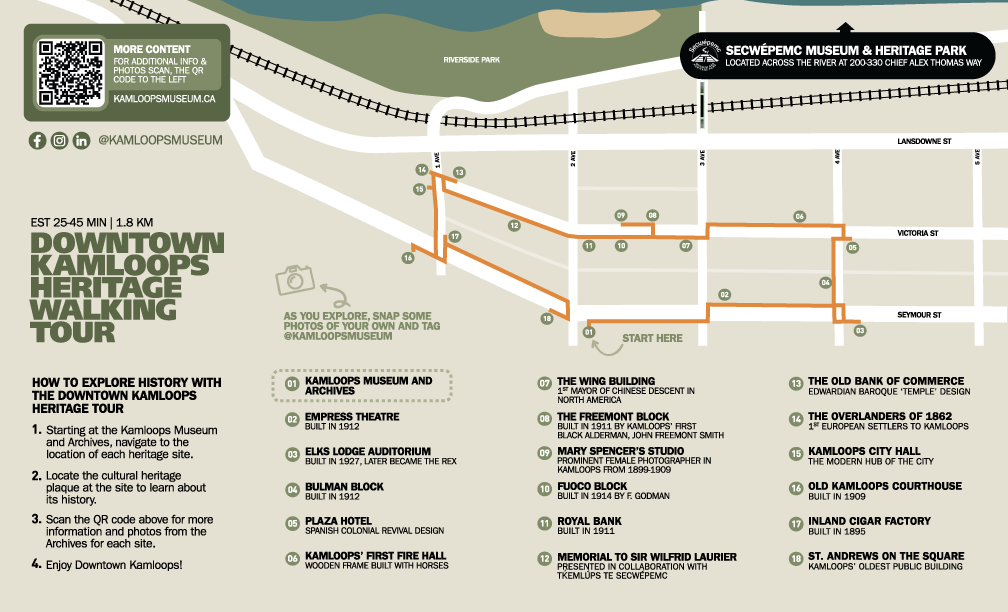
This is a stop on our self-guided tour is designed to be followed along with a physical version of the map available at the Kamloops Museum and Archives or simply enjoy the information below. View all tour stops.
-
Museum Hours
Tuesday - Saturday: 9:30am - 4:30pm
Sunday & Monday: Closed -
Archive Hours
Tuesday - Friday: 1:15pm - 4:00pm
Saturday: By Appointment
Sunday & Monday: Closed
The FreEmont Block
John Freemont Smith, a trailblazer, and voice of early Kamloops | Stop #08
Table of Contents
- An Overview of John Freemont Smith's Life
- From St. Croix to Kamloops: A Global Life Begins
- Into the Interior: Gold, Coal, and Community Building
- The Mica Mines: High Hopes in Hard Terrain
- Published: The Writer and the Voice
- Building Kamloops: Civic Leadership and Lasting Influence
- A Family Man: Children and His Final Years
- Additional Photos from the Archive
Related Archives Material


An Overview of John FrEemont Smith's Life
John Freemont Smith’s life was extraordinary by any measure. Born in 1850 in Frederiksted on the island of St. Croix, he journeyed from the Danish West Indies to Copenhagen, Liverpool, Russia, Peru, and eventually to British Columbia. Along the way, he trained as a bootmaker, worked as a cobbler across continents, and arrived in Victoria in 1872 with the skills and curiosity that would shape a remarkable life of service and exploration.
After moving to Kamloops in 1884, Smith became a fixture in the early development of the region. He ran a shoe store, opened a ranch and general store in Louis Creek, and became one of the first to prospect for gold, coal, and mica in the North Thompson. His mica expeditions near Tête Jaune Cache were ambitious and physically demanding, involving weeks-long journeys on foot and horseback through mountainous terrain. The deposits he uncovered were considered among the finest in the country, and his field reports show a sharp mind deeply attuned to the land.
Smith’s contributions extended far beyond business and prospecting. He was an eloquent and prolific writer who published his work in newspapers across North America, played a key role in organizing civic institutions in Kamloops, including the Agricultural Association, the Conservative Association, and the Board of Trade. Smith also served as alderman, then City Assessor, and later Indian Agent, where he advocated for farming, irrigation, and education programs. Even into his eighties, Smith remained involved, writing and working until the day of his death in 1934.
His personal life was marked by quiet resilience. He and his wife Mary, a talented musician, raised six children and were active participants in the social life of early Kamloops. They endured personal loss with the deaths of their sons Clarence and Leo and continued to lead by example through decades of change.
Smith’s legacy is built not only on his many achievements but also on his belief in possibility, his tireless work ethic, and his sense of humour in the face of challenge.

From St. Croix to Kamloops: A Global Life Begins
John Freemont Smith’s life was anything but ordinary. Born in 1850 in Frederiksted on the island of St. Croix, then part of the Danish West Indies, Smith would go on to shape the civic, commercial, and cultural life of Kamloops in ways still felt today. His journey to British Columbia was long, ambitious, and driven by curiosity, resilience, and a deep sense of purpose.
As a young man, Smith won a scholarship to study in Copenhagen, Denmark. From there, he continued his education at the Jesuit College in Liverpool, England, where he also trained as a bootmaker. These formative years prepared him with practical skills but also exposed him to a much wider world. One he was eager to explore.
In 1870, he began travelling extensively across Europe. Supporting himself as a cobbler, he worked in Archangel, Russia, then in Paris, and in several cities along the Mediterranean. By 1872, he sailed to Peru, intending to settle. But within the year, he returned briefly to Liverpool before setting off once again—this time around Cape Horn to San Francisco and then north to Victoria, British Columbia.
In Victoria, Smith established a shoe store and quickly built a strong reputation for his craftsmanship. He also spent time in the Cariboo as a prospector during one of the later gold rushes. In 1877, he married Mary, a member of Victoria’s Black community.
The couple had two children while living there. However, both passed away in infancy—a personal loss that marked their early years together.

Into the Interior: Gold, Coal, and Community Building
By the early 1880s, John Freemont Smith had his sights set on the Interior of British Columbia. In 1881, he and Mary left Victoria for New Westminster. Then they moved on to Lytton, which at the time was a hub of activity as construction of the Canadian Pacific Railway pushed forward. There, Smith served on several juries during trials overseen by the influential Judge Matthew Begbie. He admired Begbie’s firm but fair approach to justice, and those early civic experiences seemed to leave a lasting impression.
In 1884, encouraged by freighter James B. Leighton, the Smiths relocated once more. This time to Kamloops! They travelled by stagecoach to Savona and completed their journey on the Spallumcheen, a steamer travelling the Thompson River. Kamloops was still taking shape as a railway town, and Smith arrived at the right moment to leave a mark.
John Freemont Smith purchased land from Jesse Lee Smith, the proprietor of the Pioneer Saloon, and built both a home and a small cabin to serve as his shoe shop. However, John Freemont Smith was never one to stay within a single role. Before long, he acquired land at Louis Creek and started a ranch.
He also returned to prospecting, opening a store in Louis Creek in 1886, likely operated by Mary, while he scouted the surrounding region. He was the first to report gold at Dunn Lake and along Dixon Creek. A year later, he cut a trail through to Adams Lake and collected promising mineral samples. By 1888, he was exploring Barriere Lake, reporting additional mining prospects there.
His curiosity extended beyond the land. During these same years, Smith became a regular contributor to several newspapers. His articles appeared in the Cincinnati Tribune, The Plaindealer, the Detroit Times, the Vancouver World, and the Inland Sentinel. He was a capable, engaging writer who used his platform to share what he found, advocate for development, and document life in the North Thompson.
Smith’s attention soon turned to coal. By the early 1890s, he discovered deposits at Chu Chua (the location of the main village of Simpcw First Nation) and formed the Kamloops Coal Company. The coal was of high quality, but the challenge of moving heavy material over difficult terrain proved too costly. The company shut down the following year. Still, his belief in the area never wavered. When interest in coal revived in 1911, Smith was among the first to return and stake claims.

The Mica Mines: High Hopes in Hard Terrain
Among John Freemont Smith’s many ventures, his work in the mica-rich mountains near Tête Jaune Cache stands out. These expeditions required the endurance of an explorer and the precision of a surveyor, all carried out in some of the most remote terrain in the province.
Smith first travelled into the upper North Thompson in 1886 with Chief Louis and members of his community. That early trip focused on the fur trade, but the landscape left a lasting impression. He returned in 1891 as a prospector and found valuable deposits of mica, a mineral prized at the time for its clarity, flexibility, and heat resistance.
In 1894, Smith led a small team of two miners and two Indigenous packers. It took them 21 days to reach the Canoe River crossing. From there, they pushed into the mountains and traced mica outcroppings for more than ten miles. Despite early snow and rough trails, the trip was a success. Smith wrote of catching salmon and trout along the way, noting that “trout take kindly to bacon as bait.”
The following year, he returned with a larger group that included miners, surveyors, and his trusted packer, Sleepy Joseph. They brought back 1,500 pounds of mica, including smoky and ruby-tinted samples. The largest blocks weighed up to 50 pounds. Smith believed the deposits had been exposed by glacial movement and described the area in detail through his field reports.
In 1901, he led another expedition with a mining engineer and government surveyor. They cut trails, mapped new claims, and documented the scale of the deposits. Smith believed they were among the largest mica fields ever discovered. The only obstacle was moving the mineral out of the mountains.
Eventually, he sold the claim to an American company, although little development followed. Still, he remained committed to the area, continued his fieldwork, and advocated for improved access. The mica mines may not have brought the riches he envisioned. Still, they reflected his persistence, vision, and belief in the land’s promise.

Published: The Writer and the Voice
John Freemont Smith did not just explore the land; he documented it. He had a sharp eye for detail, a gift for language, and the ability to explain complex ideas with clarity and ease. Over the years, his writing appeared in publications across North America, including the Cincinnati Tribune, The Plaindealer, the Detroit Times, the Inland Sentinel, and later the Vancouver World.
His articles covered everything from mining activity and agricultural potential to the possibilities of the North Thompson and its transportation corridors. He consistently made the case for investment and development in a region that many still viewed as remote. His tone was measured but never dry. His observations were thoughtful and often deeply personal.
He also brought a subtle sense of humour to his public life. Speaking to a local organization later in life, he once began by saying, “I’m not sure why you asked me to address you. I suppose it is just because you need a bit of colour to enliven your proceedings.” It was a knowing remark, delivered with quiet confidence and a full awareness of how he was perceived.
Smith often described himself as “the first white man to explore the North Thompson,” adding, “if by white you mean non-Indian.” It was a phrase chosen carefully, challenging how settler stories were framed and who was given credit for the discovery.
Through his writing and public speaking, Smith carved out space for himself in a place that often overlooked men like him. He understood the power of words, and he used them to ensure that his voice and his experiences would not be forgotten.

Building Kamloops: Civic Leadership and Lasting Influence
When John Freemont Smith and his family returned to Kamloops in 1898, it was under difficult circumstances. Their home in Louis Creek had been destroyed by fire. But in the years that followed, Smith helped shape the growing city into something stronger, more connected, and more forward-looking.
He was deeply involved in civic life. In 1895, he helped establish the Agricultural Association, which supported local farmers and brought attention to the potential of the surrounding land. In 1898, he played a key role in forming the local Conservative Association. Four years later, in 1902, he helped found the Kamloops Board of Trade and served as its secretary for a full decade.
That same year, Smith was elected alderman. He remained on the city council until 1908, when he was appointed City Assessor. His work was steady and respected, marked by fairness and a deep knowledge of the region. In 1912, he was appointed Indian Agent, a role that connected back to his earlier travels through the North Thompson. He had long standing relationships with Indigenous communities and had previously taught shoemaking in the residential school system. As an agent, he supported irrigation projects and encouraged modern farming practices where possible.
Smith remained active well into his later years. He helped organize the first bull sales in Kamloops and served for many years as president of the Kamloops Cannery. Smith continued to write and speak publicly, always advocating for the Interior and its future.
On the day of his death in October 1934, he submitted an article to the Inland Sentinel reflecting on the early days of settlement in the region.
His work was never about one single title or role. Smith understood that building a city meant showing up, contributing ideas, and staying engaged long after the spotlight moved on. His influence was steady, woven into the civic and commercial fabric of Kamloops.

A Family Man: Children and His Final Years
Behind John Freemont Smith’s public life was a deeply rooted family story. He and his wife Mary shared more than fifty years together. They moved across the province, raised children, and contributed to every community they called home. Mary was musically gifted and well-known for training local performers, especially for concerts and holiday events. The couple earned wide respect in Kamloops, not just for what they did but for how they lived. Their generosity, persistence, and quiet leadership stood out in a city that was still finding its shape.
They had six children. Their eldest son, Clarence, died of meningitis in 1903 at the age of eighteen. Their other son, Leo, trained as a journeyman printer but later joined the Royal Montreal Regiment during the First World War. He was killed overseas in 1918. The loss of both sons was a grief the family carried privately, even as Smith remained active in public life.
Mary passed away in 1927, shortly after their golden wedding anniversary. Smith stayed in Kamloops, continuing his work and writing well into his eighties. He never stopped contributing. On the day he died in October 1934, he had submitted an article to the Inland Sentinel about the early days of settlement in the region.
He was 84 years old. He was survived by his four daughters—Beatrice, Christina, Theresa, and Amy—who left Kamloops not long after his passing.
Smith’s life stretched from the Caribbean to the Cariboo. He walked mining trails, cut wilderness roads, opened businesses, and helped shape the civic foundation of Kamloops.
John Freemont Smith did not seek the spotlight, but his presence helped light the way for others. His legacy is both visible and quiet, woven into the places he touched and the people he worked beside.
He is part of the story of Kamloops, and he always will be.
Community Groups
The Unique Get Together Society is a registered charity that supports marginalized communities in BC through all-inclusive, multicultural programs and services.
Photos From The Archive
Click each image for photo details.